It’s the Friction, Stupid
CONTEXT
A few weeks ago, the fridge in my kitchen died. I was able to quickly transfer everything out to the second fridge in my detached garage. I purchased a new fridge the very next day, but it took a week to be delivered. During that week, if I wanted to eat, I had to go out my back door and traverse the massive five metres or so to the fridge in my garage. Talk about a first world problem. In the week it took for our new fridge to arrive, I had lost almost three kilograms.
THE BIG IDEA
Change doesn’t come from telling people what to do; it comes from shaping what’s possible, so that the behaviour you want emerges as the natural thing to do. Behaviour follows the lowest friction gradient. People overwhelmingly do what their environment makes easy and avoid what it makes hard. Not because they’re lazy or unmotivated, but because the gradient between the two paths is doing the work for them, every minute of every day.
It doesn’t take much of a shift in the friction gradient to alter behaviour. In 2006, Brian Wansink and colleagues published a study called “The Office Candy Dish: Proximity’s Influence on Estimated and Actual Consumption.” They placed bowls of chocolate in office workers’ environments. Sometimes the bowl sat on the person’s desk (within easy reach); other times it was placed about two metres away, requiring the person to stand up. Simply moving the candy bowl from on the desk to about two metres away reduced consumption by about 1.8 candies per day on average.
Moving my food a mere five metres away to the garage fridge created enough of a friction gradient that I lost three kilograms in a week. I just couldn’t be bothered to go all that way until I was lightheaded and fatigued with hunger.
Change efforts fail because they target motivation instead of friction. The main lever you have to influence behaviour isn’t motivation. It’s friction — and that’s exactly what most change management gets backwards. Most change efforts are based on pushing information, WIIFM statements, and lofty visions in an attempt to influence motivation, mindset, and resistance. This is the wrong approach because you’re asking people to walk uphill through a system that has spent years grading itself to push them downhill. Friction compounds daily. Motivation has to be renewed daily. For repeated, everyday organizational behaviour, friction almost always wins that contest.
There’s another reason why a focus on motivation, mindset, and resistance is wrong. They’re interpretations, not observations, you can’t directly change them, and they’re usually the outcome of friction anyway. Focusing too much on how people feel about change is one of the biggest anti-patterns in conventional change management. There is no motivation lever.
LESSONS FOR MODERN CHANGE MANAGEMENT
Friction Mapping is a practice I’ve been developing and testing for a few years. I haven’t been this excited about something in a long time.
If friction is the lever, we need a way to see the friction landscape so we can act to shift it. The idea is to map the system constraints that show where the energy for change tilts in your system today, and where to reshape it so new behaviours become the easier choice.
Instead of asking “how do we motivate people to change?” Friction Mapping asks a different question, captured in a short conceptual equation:
ΔBehaviour = Fc − Fd
Fc is the friction on what people already do; Fd is the friction on what you want them to do instead. Read it left to right: the amount of behaviour change you’ll see is governed by how much harder the old behaviour is than the new one. When Fc is much bigger than Fd, change flows. When they’re roughly equal, you get inconsistency. When Fd is bigger than Fc, the system actively pushes people back to the old behaviour — no matter what they were trained to do.
The implication is simple but transformative for change practice: lower the energy gradient to the change you want. Don’t push people uphill, make the uphill less steep, or make the downhill less appealing. That’s what Friction Mapping is designed to do.
In practice, Friction Mapping runs in six steps:
1. Define Outcomes: Name the current result you’re getting and the result you actually want, in terms specific enough to observe. If you can’t see it happening, you can’t map it.
2. Define Behaviours: Break the outcome down into the specific, observable actions that produce it — not attitudes or mindset, but things people actually do.
3. Identify Constraints: List the controllable factors in the environment that make those behaviours easy or hard: policies, tools, incentives, workflows.
4. Map the Constraints: Place each constraint on the friction map to show whether it’s pushing people toward the old behaviour or the new one.
5. Indicate Effort to Shift: Rate how hard each constraint would be to shift, so you can see the quick wins versus the longer fights.
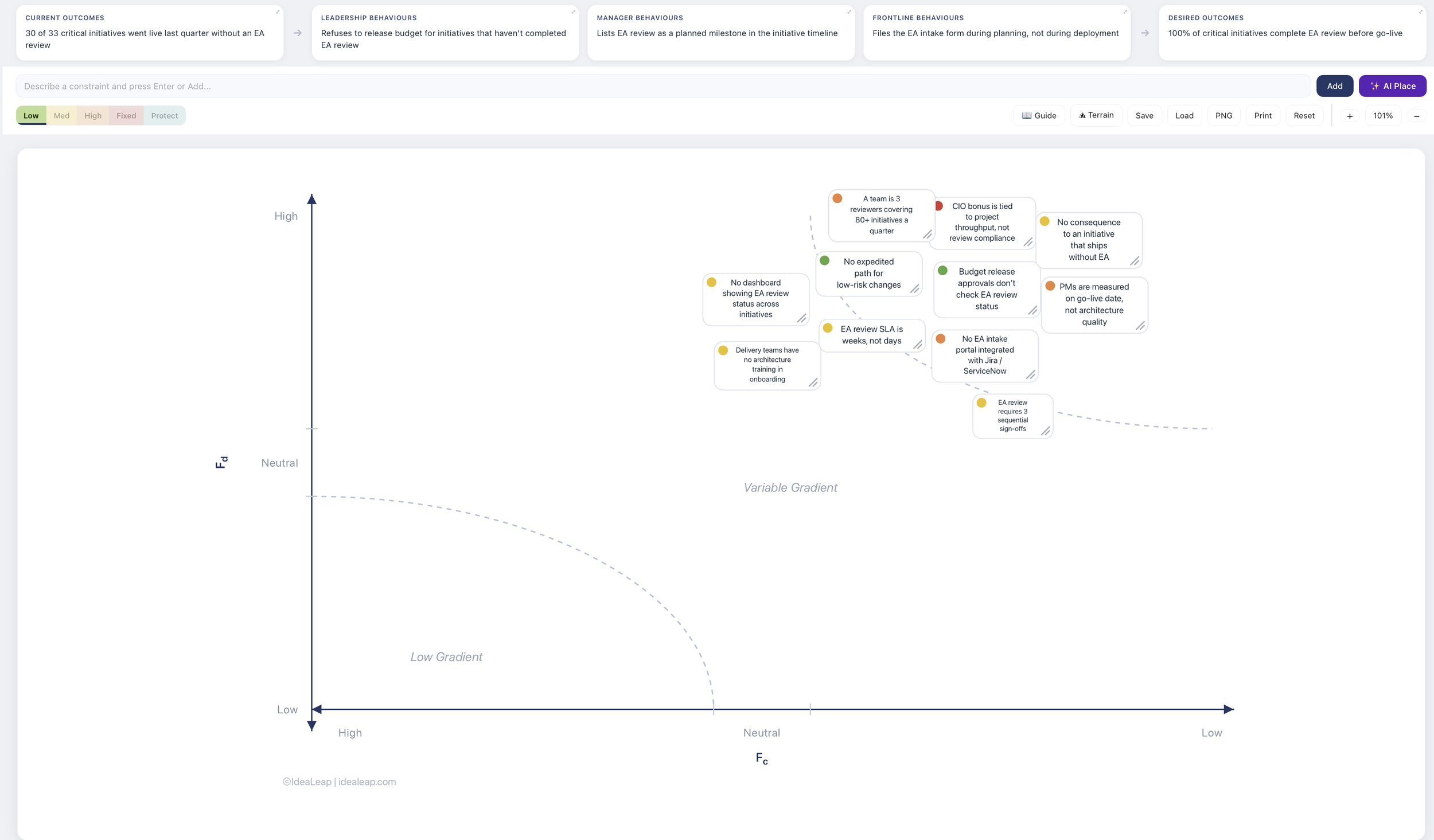
6. Adjust the Gradient: Pick the highest-leverage constraints and run small, reversible experiments to shift them, then remap and check whether the gradient actually moved.
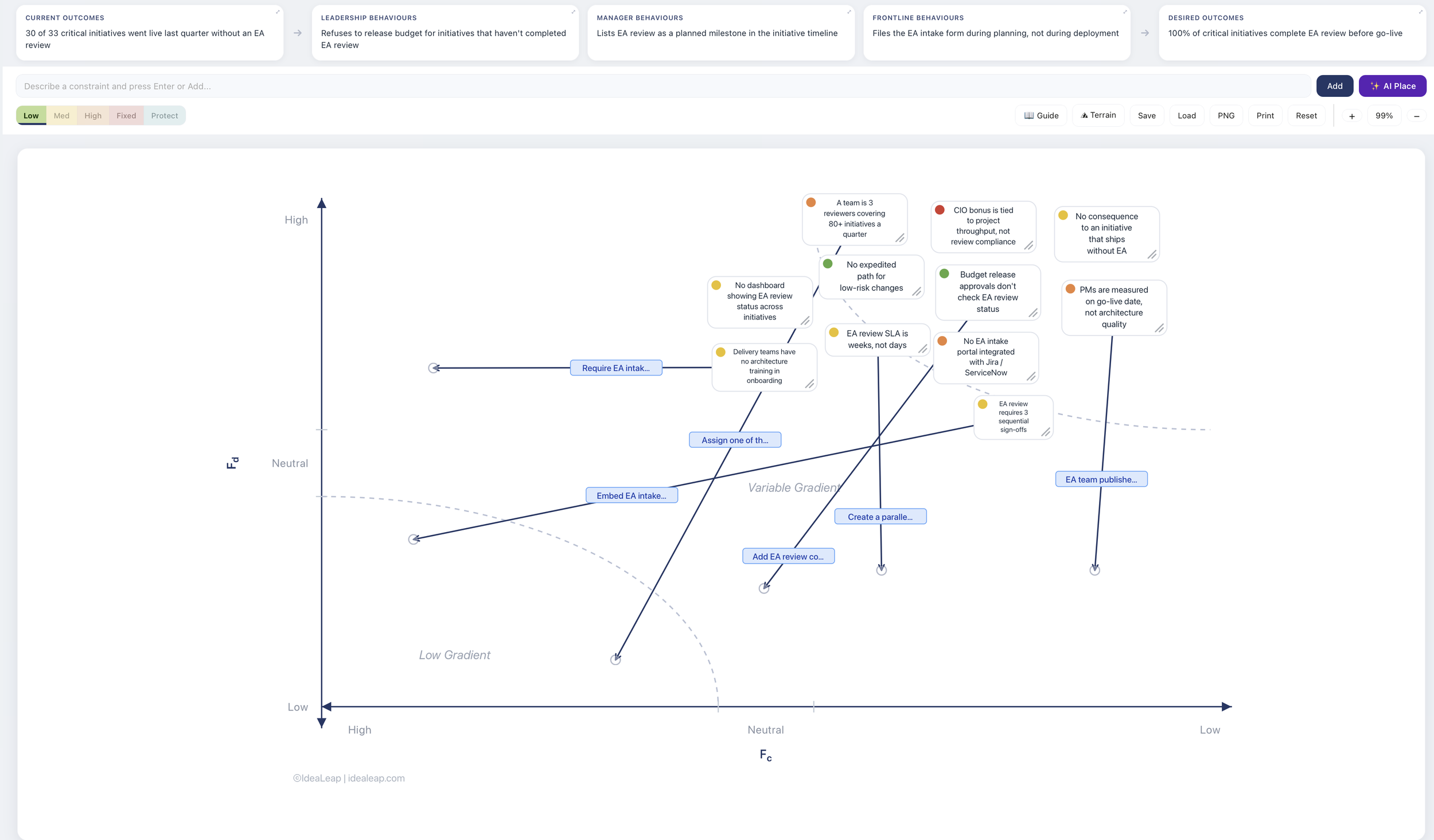
A Friction Map in action — constraints placed, effort labelled, and intervention arrows drawn.
Below is another view of this example of the Friction Map from the AI-powered, always-on Friction Map available to the IdeaLeaper community. What you’re looking at is the friction landscape rendered as terrain. Elevation is friction: the higher the ground, the harder that behaviour is to reach. The desired behaviour sat high on steep terrain, so almost no one climbed to it — the easy, low-effort path still led back to the old way.
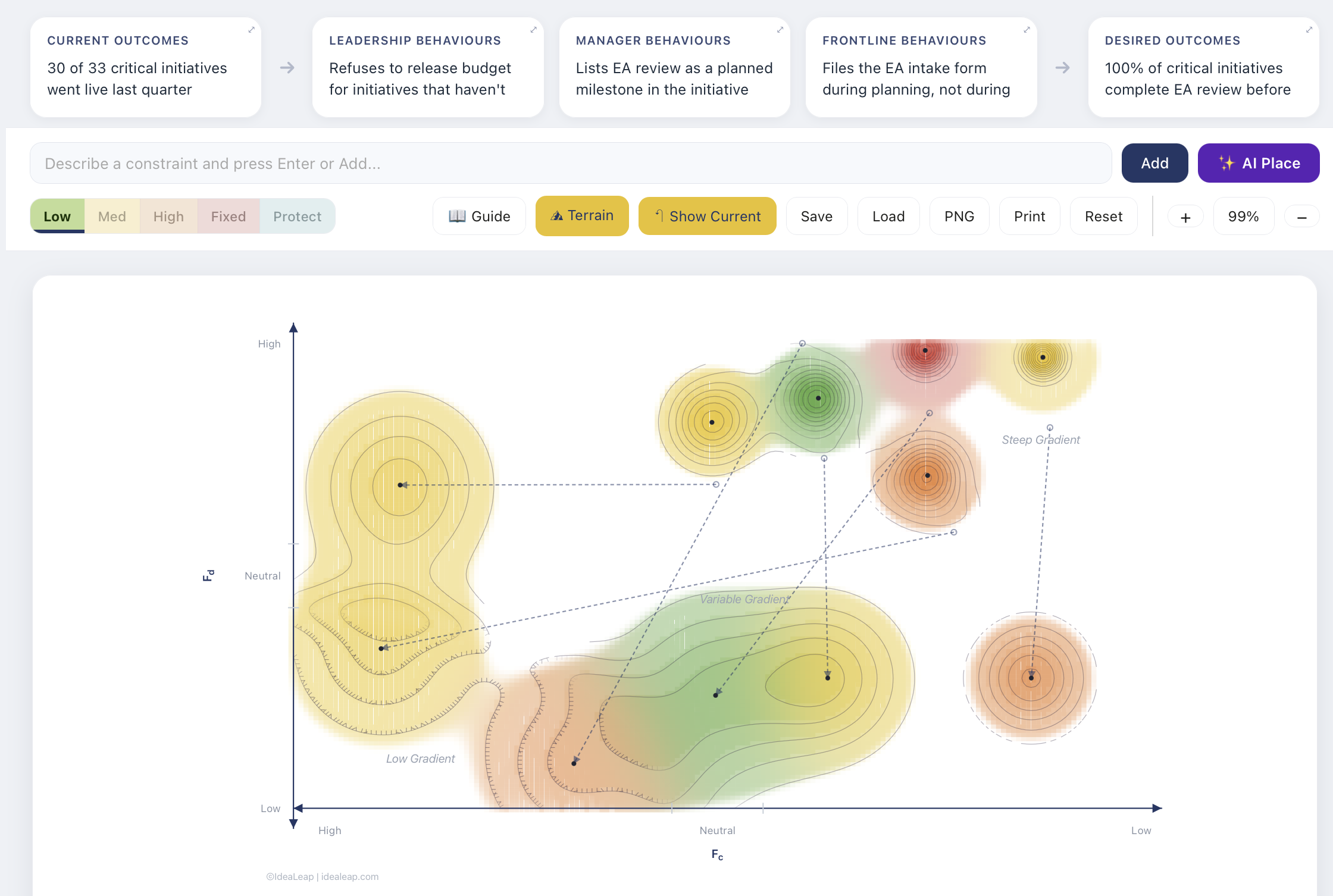
After Friction Mapping identified and shifted the constraints holding that ground up, the terrain flattened. The same behaviour now sits on low, easy ground — the path most people will take without being told to.
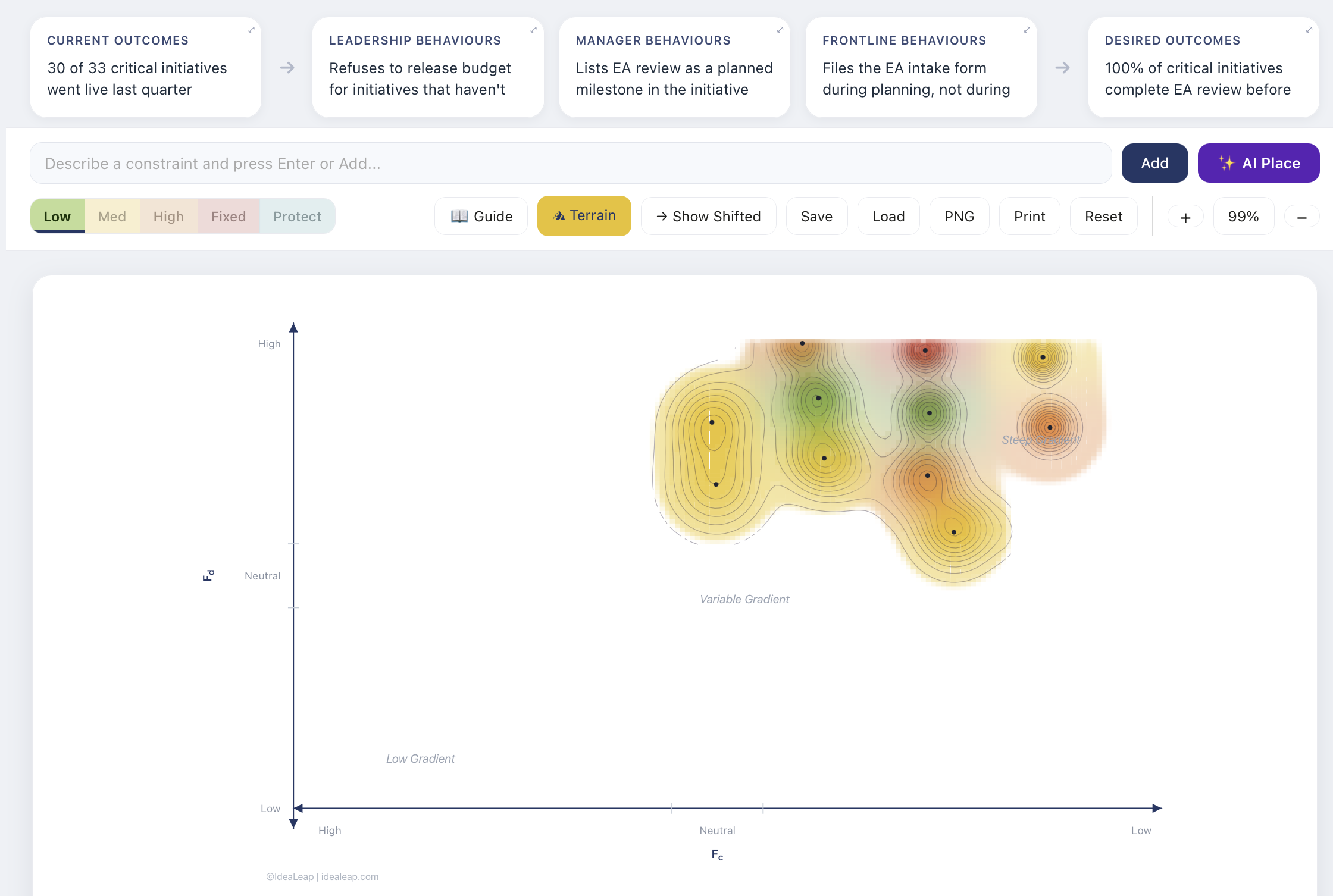
This Friction Map has built-in AI coaching that helps you place constraints correctly on the map, design interventions for the ones worth moving, and predict where they’ll actually shift the gradient, before you spend a single change-management dollar testing it in the real world.
If these ideas resonate and you’d like to explore further, consider checking out the following:
Friction Mapping Self-Study Course — work through the full framework at your own pace.
Friction Mapping Masterclass — everything in the self-study course, plus four live, instructor-led online sessions and certification.
Join the IdeaLeaper Community — ongoing access to the AI-powered, always-on Friction Map tool, plus more resources and support.
Thanks for reading! If you try Friction Mapping on something in your own team, I’d genuinely like to hear how it goes.